

…or what if we actually punish people who pilot their two-ton death machines irresponsibly?
Remember, though: if the punishment is a fine, then to the rich, it’s not a punishment. It’s a price.
You don’t even have to be rich-rich. Car-related fines are a joke.
I was thinking more along the lines of losing one’s license.
Indeed, though I would suggest that, for more significant infractions, state seizure of the vehicle (as the tool used to commit the crime) should be an option, with proceeds from vehicle sales by the state going to safety infrastructure and perhaps a victim restitution fund.
People are very attached to their cars, so that’s a punishment, and they won’t be needing it anymore without a license!
It’s a good thing to have more green lights, because emissions drop a lot. A few cities in my area spent a lot of money in the 1970s to do that. But the problem is that they sync at 30, and also at higher speeds.
Fix road design so that people don’t speed. A six lane stroad signals a limit considerably higher than 40kph, no matter what you do with the stoplights.
Road design doesn’t really stop people from speeding.
It does. When the risk isn’t a fine but hitting a curb or raised midsection or wooden pole, people actually slow down. I’m pretty sure I have seen studies on that, but can’t look them up now.
Also roundabouts. Can’t go 40mph through one of those.
Maybe you can’t.
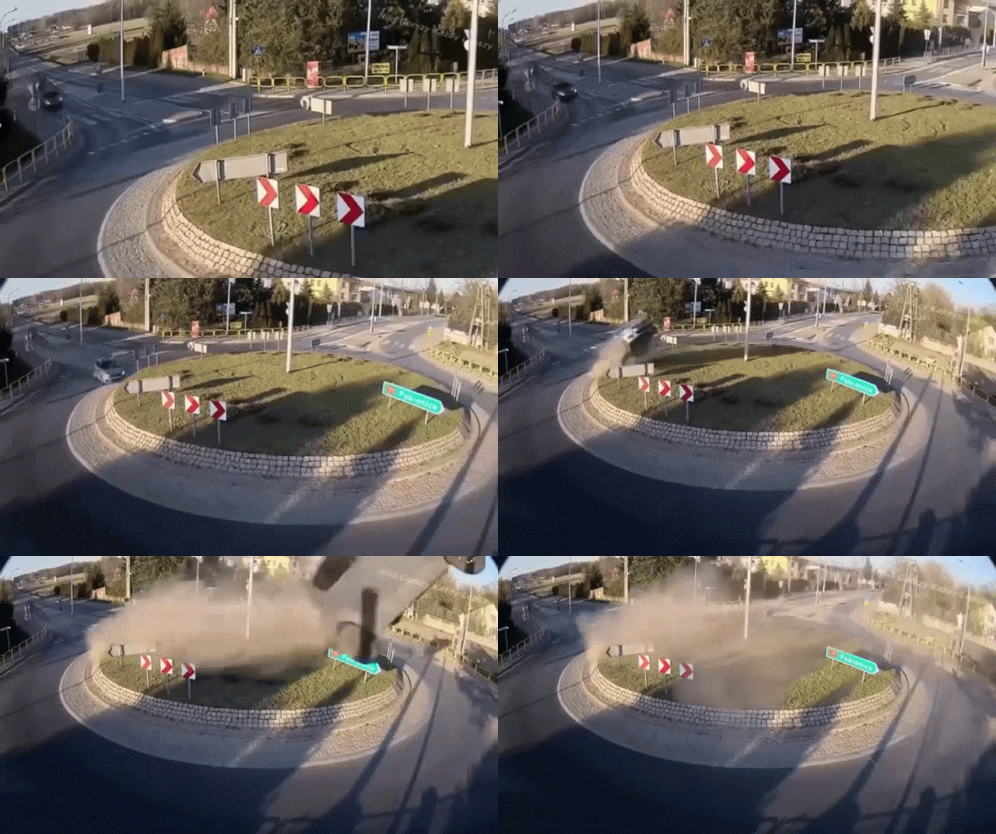
this is Lombard Street in San Francisco

you think anyone’s ever broken the 25mph speed limit on that section of street?
Yes, if their breaks failed … briefly.
Do you have anything to back that up?
Noted car enthusiast NotJustBikes disagrees. And so do several generations of traffic engineers, not just in the Netherlands. https://m.youtube.com/watch?v=bglWCuCMSWc
Traffic calming doesn’t stop speeding, but it stops ubiquitous speeding - the situation where the speed limit is 50 but traffic flows at 70.
Anything except public transportation
Do you want traffic lights to only turn every 5-10 minutes? Lights were always going to be changing more than transit was arriving, if altering how it changes slows speeding drivers why wouldn’t you want that?
I don’t want traffic lights. If you design your cities properly (with no personal cars) traffic lights are not needed at all. Outside cities traffic lights don’t make sense anyways, intersections there are better off as roundabouts.
Sounds great, but I don’t live there and do have to deal with drivers and traffic lights, and I would like to implement whatever measures will slow them down. If the first and easiest is altering traffic light patterns, cool, do it. I’m supposed to not want this?
It depends on whether this is about retiming existing lights (which is relatively cheap) or building new ones. Retiming existing lights is fine, building new ones just shows that engineers don’t care about the problem and would rather waste millions of $ on a non-solution.
I don’t see anything in the article about building more lights, just altering the timing so that the default light state is red instead of green.
Almost all commenters find some problem with this, but I have seen this work on my own dad who unfortunately prefers going 10kph over the speed limit most of the time. Either the traffic lights are timed in sequence or sensors are placed so that with low traffic, lights stay red until a car approaches and the light is timed with the location of the sensor for going the speed limit. The last one also allows pedestrian and bike lights to stay green when there isn’t any car traffic.
just make all lights green. problem solved
How about just magnetic sensors near intersections that count how many cars are approaching and do some math to decide what would be the most efficient. If no cars coming in the cross streets then dont turn the light red in the opposite direction.
Nothing angers drivers more than sitting through a full cycle and nobody used the green.
This can be solved with sensors and math.
No fucking AI in my traffic lights!
This is actually a thing in some places. I’m sure the cost is why it’s not more widely adopted.
Cost vs flock rollout? (Lol, you mean no profit motive, so no special interests to push it through local government kickbacks)
Cost vs total fuel saved by efficiency gain? (Lol, different budget right?)
Can’t fix opex problems with capex dollars.
Did a speeding driver write this?
I’ve seen lights with sensors several blocks back that will turn red if you’re going too fast.
Another solution is to go back to actually enforcing it in a meaningful way.
Also you can’t get all lights everywhere synced up that way, and it would only work in places that have a significant number of lights. Places that have 3 on Main Street are still going to have problems.
Maybe there should be more lights? That way we don’t have little old ladies crossing 6-lane stroads without a crosswalk to get to the market, while the nearest crosswalk is a half mile in the wrong direction.
Obviously this only works where there’s one major throughway and most perpendicular streets are minor…like every retail center in every city >35k pop in the country. These roads often have very predictable traffic patterns.
Getting lights synced up for a consistent speed is the easy part.
We need more roundabouts, too.
There should be less car infrastructure, not more. Crossing a 6-lane road will suck regardless. Both asphalt roads and traffic lights are very expensive to build and maintain, better to invest a bit more up-front in tram tracks and rip the socioeconomic benefits for decades to come.
Those kinds of places, usually only have one or two blocks worth of store front anyways. The Walmart. The big box hardware store, two churches, cafe and 3 bars.
I do agree we should make our roads safer, but that’s really not going to happen in small town America. Especially when you’re already not enforcing basic road safety laws
Eh. Maybe reduce a few, but not stop.
Some people like being at the back of whatever pack of cars are in front of them, so they speed up to tailgate.
While I like the idea, (timing the lights so going the speed limit keeps you going with no stops), this doesn’t solve speeding at all. You will always have people who will drive 30 over the limit. You’ll still meet them as the next light turns green. Or they’ll start running more reds. Which is already becoming more of a problem.


