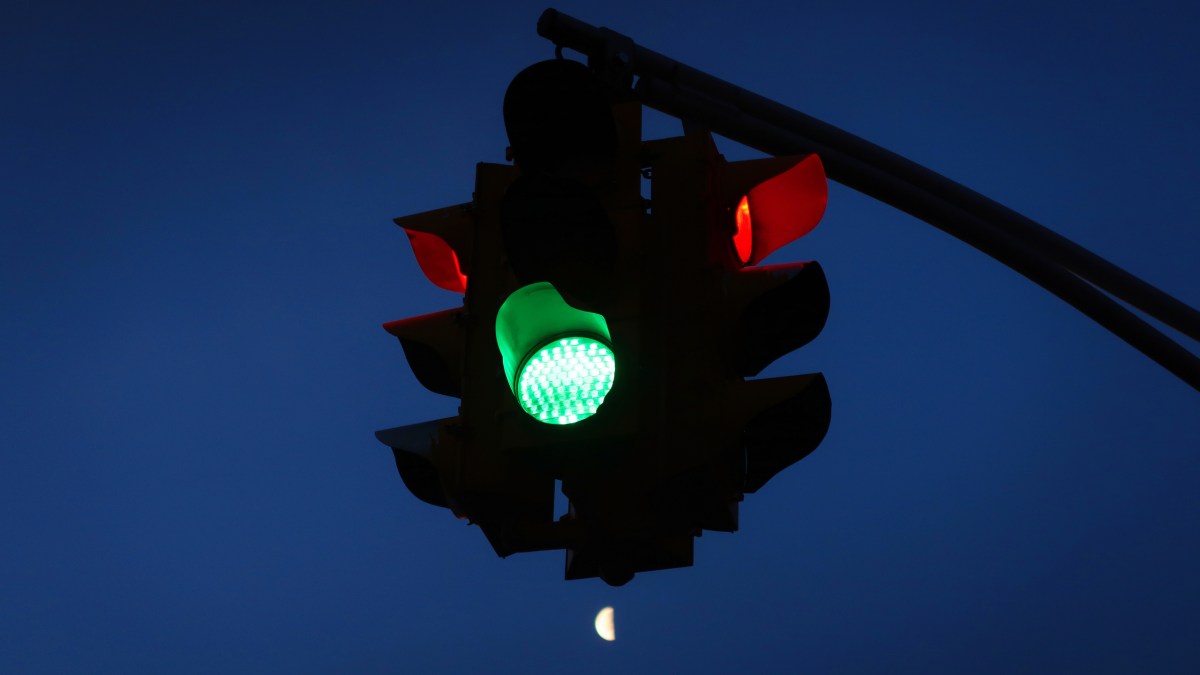
There’s one street in a major metro near me that has been timed this way for decades and it’s incredibly noticeable because it is a dead straight thoroughfare through a few dozen small blocks of housing. You can see the next 3-5 lights lined up ahead of you at all times. You absolutely learn to pace yourself so you aren’t stopping/starting constantly, looking like an idiot when you get to the next light too fast and have to stop and then watch slow cruising cars whip past you when the light turns green. It’s like a game. I think about nothing else when I’m on that street. Not even remotely new, and it definitely works. But you have to pick which big street gets this treatment and then all streets intersecting with it have to work around that.
Yep. My hometown went to speed limit timed lights over 20 years ago. It was fantastic if you could catch the “Green Wave” and make ot all the way through a busy part of town without stopping.
there’s a similar street that they’re recently changed like that in my small city. it’s a 25 street. my bike only does 20 until fix the front derailleur. if i catch the front of the wave and don’t have anything heavy in my basket i can usually make 4 or 5 lights in a row before i hit a red and it’s glorious.
In France they installed roundabouts. And a lot of them. I mean really a lot! It works.
Please dont put anymore roundabouts in the US until its included in the drivers license test. Every trip to work is a gamble and I have to slam my breaks while in the circle at least once a day, people will even use the right turn only lane to go fully around…
The best way to stop drivers from speeding is to take their licence if the caught speeding
Nah, then you just get unlicensed drivers.
Proper road design and good alternatives in public transit will make the biggest difference.
If you read the article it’s very obviously advocating for fewer green lights. I’ve no idea what this headline is on about
"Essentially, rather than encouraging drivers to speed up by presenting an endless succession of green lights, this strategy makes red the default state for lights on a busy road. When traffic approaches the red light, the cycle triggers. Traffic moving faster than the limit will approach the light while it’s still red, forcing it to slow or stop for the light before it changes, while traffic moving at the limit will be met with a perfectly-timed green.
Drive the limit, in other words, and you’re rewarded with a constant rhythm of green lights."
That’s why the title makes sense
It’s a good thing to have more green lights, because emissions drop a lot. A few cities in my area spent a lot of money in the 1970s to do that. But the problem is that they sync at 30, and also at higher speeds.
Fix road design so that people don’t speed. A six lane stroad signals a limit considerably higher than 40kph, no matter what you do with the stoplights.
Road design doesn’t really stop people from speeding.
It does. When the risk isn’t a fine but hitting a curb or raised midsection or wooden pole, people actually slow down. I’m pretty sure I have seen studies on that, but can’t look them up now.
i can point to specific roads in local cities that they probably used for those studies. been that way for a few decades now out in sacramento specifically. they shifted the lanes a little bit, narrowed the road, and moved the curb/sidewalk/crosswalk such that (1) there’s less road to cross and (2) traffic slows down because the road naturally slows down before the crosswalk. also added botts dotts to give a little rumble as you cross the crosswalk in your car.
Also roundabouts. Can’t go 40mph through one of those.
Maybe you can’t.
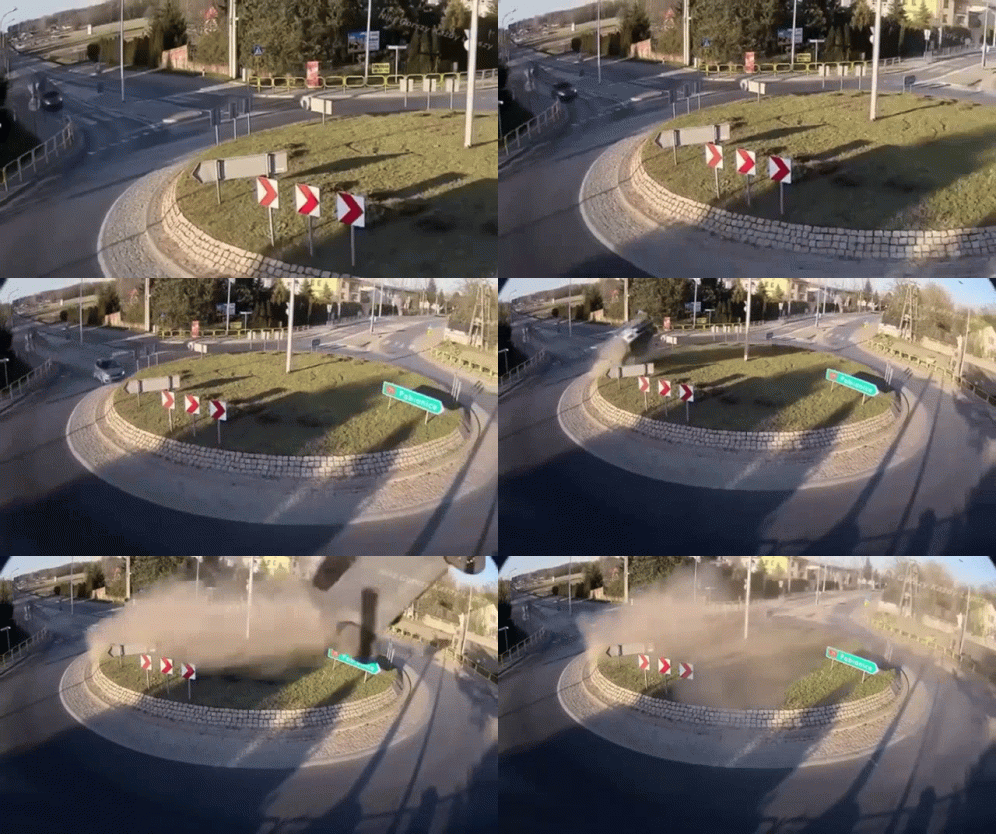
How did you get a video of me?!
i paid you tacos. that landing was worse than i thought
Username checks out
The data I’ve seen says it does.
If you design a road to be safe to drive 60, people will drive 60 even if you post a limit of 35.
The exceptions are places where there is always a traffic cop waiting to ticket you.
this is Lombard Street in San Francisco

you think anyone’s ever broken the 25mph speed limit on that section of street?
i don’t think i’ve even taken my foot off the brake on that stretch.
also, note to any y’all who want to visit, it’s a gorgeous walk down the street but you do not want to drive it. this photo does not do the grade justice

Yes, if their breaks failed … briefly.
there’d be a car in front of them to brake their descent
Noted car enthusiast NotJustBikes disagrees. And so do several generations of traffic engineers, not just in the Netherlands. https://m.youtube.com/watch?v=bglWCuCMSWc
Traffic calming doesn’t stop speeding, but it stops ubiquitous speeding - the situation where the speed limit is 50 but traffic flows at 70.
Do you have anything to back that up?
Projection much
The main street for all the businesses in a nearby city is set up so you can hit all green lights going down the road from 2pm-~6pm, however if you get caught at a SINGLE light, you’re going to hit reds all the way down.
So it’s become “oh that light is about to change better engage T U R B O M O D E and speed 20mph over the limit to beat this light and stay with the greens” which turns out very predictably at least once a month.
Last week a car rolled twice while speeding up to beat the light and clipped an ambulance coming from another street.
The DOT planning department I worked for (in the 80s) had studies showing that synchronizing the lights 10-15mph ABOVE the speed limit kept traffic flowing “optimally” to minimize congestion without having to expand the infrastructure (mostly: lanes). Even today I see city traffic lights synchronized mostly +10mph over the posted limit in the direction of highest flow on major arteries - you can tell when you “make” one yellow light, then lock in cruise control at limit+10 and “make” the next 3+ lights at exactly the same flash of yellow as you approach.
They do this to delay improvement projects like additional lanes, straightening curves, etc. by showing a higher “level of service” for the roadway than they would have with the lights synchronized at, say: speed limit -10mph. If you’re talking about a 45mph roadway, moving the cars at 55mph instead of 35mph means 157% as many vehicles per hour at the same spacing, and we all know that people don’t actually increase following distances at higher speeds, so… it’s a real, and significant difference. Not as significant as getting people to carpool, or take public transit, but that’s about as likely to happen as increasing following distances.
Anything except public transportation
Never been a fan of the “we shouldn’t make the smaller, easier improvements because we need to do the bigger, harder things instead” argument…
Yes, we need more and better public transit, but that is going to take a whole lot of time, money, and effort to work towards. Yes, it’s worthwhile, and we shouldn’t STOP working towards it because of this, but I don’t think that’s a reason to balk at a smaller, easier incremental change that encourages safer driving while also simply being more efficient.
More efficient is more cars per hour. When cars move faster, you can get more cars per hour through those intersections when the lights are green.
Nothing that involves the phrase “more cars” is more efficient. Cars are massively inefficient monuments to toxic individualism and ecocidal narcissism.
More cars per hour is less cars stuck in traffic on the roads… the number of cars is a given, getting them off the road ASAP is the goal.
the number of cars is a given,
No the number of cars is a policy choice.
Nobody is forcing cities and counties to only build for the carbrained, they do that on their own. If they’d make driving less convenient and transit more convenient, the number of cars would decrease significantly.
For public transportation in the US you need medium density living. So you’re talking about getting everyone on board and uprooting everyone as you upgrade cities or build new cities for that.
“Anything except making incremental improvements that are practical instead of doing nothing because the preferred goal is impossible, at least practically impossible” - not as catchy, I admit :P
I’d argue the even bigger deal is mixed zoning. You can even be in a fairly spread out, small town, if you can just walk to the local grocery store, hardware store, etc, that’s even better than needing to transit.
I rarely leave my neighborhood even in a very transit heavy city because I’ve got 3 grocery stores, a green grocer, two bakeries, a hardware store, etc, all within ~5 minutes walk. Both my kids’ schools, a pre-K-K and an elementary, are within a block or two.
A lot of this can be accomplished by simply rezoning and letting the infill slowly change.
Big box grocery is a big part of the problem. We’ve got a relative abundance of grocery stores here - in US terms, but that means a 2-5 mile interval between then, and who is going to walk several miles carrying groceries? It doesn’t help when competing groceries open directly across the street from each other, but even fixing that and making distribution of the current stores more even, there would still be a lot of the population 2+ miles to the nearest store, in our relatively high density suburban “core”. Get that down to a maximum of 1km from every home to the nearest grocery and you’re starting to have a walkable / bikeable solution for food.
As for bikes, we also have near-zero practical support for biking to get your groceries - starting to get something calling itself bike lanes, but they’re not terribly safe looking, and then you get to the store and you’re extremely lucky if there’s even a rack provided to lock the bike to - the racks that do exist seem to be in direct conflict with pedestrian use of the sidewalks.
Big box grocery is a big part of the problem
That is very true and it’s wild how fast it changed. I remember still having small grocery stores in the 90’s, but they’ve all closed down now. A few still exist as discount stores, but they aren’t true full service grocery stores, mostly frozen stuff and junk food. It definitely exacerbated the “food desert” problem a lot of the US has… a lot of folks with limited mobility only have access to these shitty faux-grocery stores, it’s kind of no wonder so many people eat like shit.
I’m not in the US anymore but that big box transformation was well and truly completed by the time I left.
I had a friend who had an apartment in Hamburg, roughly 600m from an S-Bahn station. within 50m of that station was the neighborhood grocery. You walk up to take the train to wherever, and on your way home you stop off in the Biergarten first, have a few, then stop in the grocery before walking home - downhill no less for the arms full of packages side of the trip. Not a bad layout, but about half the residents still had cars parked all over the streets which they used more or less daily. So, in some ways, the US arrangement just doesn’t bother with the under-utilized trains, but it also eliminates them as an option which really sucks when you want to go to the airport, or take an inter-city train somewhere…
I agree - I should have said medium mixed zoning as that’s what I was intending to convery :)
Also, for wheelchair users like me, higher density would probably lead to cheaper delivery services of all kinds - Walmart has that market cornered at the moment, and I hate that it’s Walmart that figured it out. :|
Do you want traffic lights to only turn every 5-10 minutes? Lights were always going to be changing more than transit was arriving, if altering how it changes slows speeding drivers why wouldn’t you want that?
I don’t want traffic lights. If you design your cities properly (with no personal cars) traffic lights are not needed at all. Outside cities traffic lights don’t make sense anyways, intersections there are better off as roundabouts.
Sounds great, but I don’t live there and do have to deal with drivers and traffic lights, and I would like to implement whatever measures will slow them down. If the first and easiest is altering traffic light patterns, cool, do it. I’m supposed to not want this?
implement whatever measures will slow them down
Spike strips?
It depends on whether this is about retiming existing lights (which is relatively cheap) or building new ones. Retiming existing lights is fine, building new ones just shows that engineers don’t care about the problem and would rather waste millions of $ on a non-solution.
I don’t see anything in the article about building more lights, just altering the timing so that the default light state is red instead of green.
Wait, you mean the thing where people who do the speed limit have to stop at 3 straight reds while people doing 15 over are able to squeeze through all of them is the result of an intentional choice? It irritates the hell out of me how often that kind of thing happens in my town, but I always thought it was just some kind of oversight or inefficiency on the part of the engineers who set up the timing cycles, given how how clearly and directly it incentivizes speeding…
If driving the speed limit is the most efficient way to get where you’re trying to go, people will tend to drive the speed limit. Seems like that should be pretty obvious, imo.
engineers who set up the timing cycles
The engineers who set up the timing cycles in my DOT planning department set the cycles to run over the speed limit intentionally to get more cars per hour through the same roadway compared with moving them slower. Accident statistics were equivocal - similar accident rates at or +10 above the speed limit, but that is a politically charged statement, so you don’t say it loudly.
Interesting… I’m curious to know more about the details of that experiment. I could think of a few hypotheses for why that might’ve happened.
My first thought is maybe that particular road’s speed limit was just lower than what it should be? If the road design and location allow for a similar level of safety at a higher speed, the limit itself might just be a bit too conservative.
Or, perhaps the previous cycle timings weren’t as effective at slowing down drivers as first thought? I don’t know the previous circumstances, though.
There’s also the possibility that speed-reducing measures just don’t have much of an impact on overall safe driving behaviors, and that dangerous drivers are going to drive dangerously no matter how fast they’re able to go. I could even see the possibility of a negative feedback loop in which being constantly being slowed down by red light cycles frustrates aggressive drivers into engaging in other dangerous behaviors, i.e. running reds.
If it’s that last case… Yeah, I don’t really know what you do with that one. I would hope that safer driving could be encouraged through positive reinforcement, because the alternatives for negative reinforcement are either a massive ramp-up in police traffic enforcement, or aggressive use of speed cameras and automated ticketing. I do not think that making people have more encounters with US police officers would do anything good for public safety, and while speed cameras could work in principle, they would be massively unpopular, and career suicide for any politician that tries to make a push for it.
Speed-reducing measures just don’t have much of an impact on overall safe driving behaviors, and that dangerous drivers are going to drive dangerously no matter how fast the speed limit and green light sync are, that’s pretty much a given.
In another county, somebody decided they wanted to screw with a 2 lane road out in the country and they narrowed the lanes - didn’t change the existing 40mph limit, not putting in space in the median, but squeezing the oncoming lanes together in the middle. Said it would “increase safety” through reduced speed, meanwhile the lanes were so narrow that school buses had to drive over the rain/rumble strips in many places to not cross the center line. Sometimes BS is just BS, a politician wanted it, so a politician got it. I called them on it, asked to see the studies backing up their statements, they didn’t have any.
Some people seem like driving is a game to them. They’ll speed ahead at a green only to slam on the brakes at the next red, as long as they can get around you first.
Herd animal instincts, desire to lead the pack…
Bullshit
More like horseshit - and if you’re smelling it, you’re not in the lead.
…or what if we actually punish people who pilot their two-ton death machines irresponsibly?
Remember, though: if the punishment is a fine, then to the rich, it’s not a punishment. It’s a price.
If it scales with income, it stays a punishment.
If it scales with wealth. The rich are very good at hiding their income.
You don’t even have to be rich-rich. Car-related fines are a joke.
I was thinking more along the lines of losing one’s license.
more along the lines of losing one’s license.
Don’t forget that the wealthy can afford lawyers to forestall license revocation, usually indefinitely.
Indeed, though I would suggest that, for more significant infractions, state seizure of the vehicle (as the tool used to commit the crime) should be an option, with proceeds from vehicle sales by the state going to safety infrastructure and perhaps a victim restitution fund.
People are very attached to their cars, so that’s a punishment, and they won’t be needing it anymore without a license!
state seizure of the vehicle
Sure, no problems with power-tripping LEOs yet, let’s give them more ability to abuse their position arbitrarily.
Power tripping murderpigs and ecocidal narcissists with their two-ton pollution powered people crushers are basically equivalent evils, anything that pits them against each other without adding any risk to pedestrians is a win.
state seizure of the vehicle
Absolutely not if you’re talking the US. We already have civil forfeiture which is abused far to easily and frequently.
My wife went to school to be a paralegal. Her first job was working asset forfeiture for a county DA’s office. That experience single-handedly made her have to go back to school to switch careers. It really is one of the most unjust aspects of our justice system, which is really saying something.
Precisely. I’m saying that, if we already have it anyway, we ought to regulate it. If we can abolish it, great. If not, then it should be heavily regulated, with the funds earmarked for things that aren’t enforcement-related, so that there’s less perverse incentive for law enforcement to just grab things for shits, giggles and greed. The government can and will seize your home for nonpayment of taxes, so it’s not like this doesn’t already happen outside of civil asset forfeiture. It’s just a matter of how well-regulated the system is, and what steps are taken to reduce perverse incentives.
less perverse incentive for law enforcement to just grab things for shits, giggles and greed
Shits, giggles and power trips are the only reason most LEOs get into the career in the first place. If they’re greedy, they go into politics.
Good point!!
Forgive me if I doubt it could be appropriately regulated and properly applied in the US.
In the current situation? Absolutely. I’m fairly certain it would take a violent uprising, then a constitutional convention, to actually count the US as a country with laws. It’s full, mask-off kakistocratic corpofascism.
There are, however, individual states and jurisdictions which could implement it well with reform.
Punishment doesn’t prevent behavior that already happened and is usually missed. Road modifications help every time.
My town has a major road that was one of the most infuriating and dangerous in town. It was two lanes in each direction, constant jockeying for position or to make the light or to get around a turning car.
All it took was repainting. Now it’s one lane in each direction with turning lanes. There is no jockeying for position since it’s only one lane. But turning cars are no longer blocking so no infuriating stop and go. They even coordinated the lights.
Now that road is slower, calmer, no road rage or angry drivers and everyone gets through in less time
that road is slower, calmer, no road rage or angry drivers and everyone gets through in less time
Perception is a funny thing. Experiencing road rage and anger distorts one’s sense of how much time something takes. The true test of “everyone gets through in less time” is a clock and a car counter.
Did a speeding driver write this?
No it was a cat
Almost all commenters find some problem with this, but I have seen this work on my own dad who unfortunately prefers going 10kph over the speed limit most of the time. Either the traffic lights are timed in sequence or sensors are placed so that with low traffic, lights stay red until a car approaches and the light is timed with the location of the sensor for going the speed limit. The last one also allows pedestrian and bike lights to stay green when there isn’t any car traffic.
the location of the sensor for going the speed limit
Unfortunately, placing sensors that far back from the intersection is costly, both in initial installation and maintenance. Most sensors in the US are right at the stop-lines for the intersection only (with frustrating effect when an overly light scooter or other phenomenon stops the sensor from sensing a vehicle).
How about just magnetic sensors near intersections that count how many cars are approaching and do some math to decide what would be the most efficient. If no cars coming in the cross streets then dont turn the light red in the opposite direction.
Nothing angers drivers more than sitting through a full cycle and nobody used the green.
This can be solved with sensors and math.
No fucking AI in my traffic lights!
Nothing angers drivers more
Most traffic engineering ignores driver mood - it’s difficult to quantify and harder still to place a value on.
Citizen rage and complaints to politicians are effective inputs to the system to get an area examined, but once the examination starts, mood generally doesn’t enter into the equations.
This is actually a thing in some places. I’m sure the cost is why it’s not more widely adopted.
Cost vs flock rollout? (Lol, you mean no profit motive, so no special interests to push it through local government kickbacks)
Cost vs total fuel saved by efficiency gain? (Lol, different budget right?)
Can’t fix opex problems with capex dollars.
just make all lights green. problem solved
Another solution is to go back to actually enforcing it in a meaningful way.
Also you can’t get all lights everywhere synced up that way, and it would only work in places that have a significant number of lights. Places that have 3 on Main Street are still going to have problems.
Maybe there should be more lights? That way we don’t have little old ladies crossing 6-lane stroads without a crosswalk to get to the market, while the nearest crosswalk is a half mile in the wrong direction.
Obviously this only works where there’s one major throughway and most perpendicular streets are minor…like every retail center in every city >35k pop in the country. These roads often have very predictable traffic patterns.
Getting lights synced up for a consistent speed is the easy part.
We need more roundabouts, too.
That way we don’t have little old ladies crossing 6-lane stroads without a crosswalk to get to the market
The solution is to not have 6-lane stroads
Sure. But those are necessary as long as we have a car dependency.
The real hard problem is breaking the car dependency…and this, like piracy, is almost always a service problem.
So the solution must be an alternative that is preferable to cars by almost every objective measure…and then we are stuck in a chicken/egg problem.
Nobody wants to make alternatives that are better (or that make driving worse), because people are going to continue to prefer driving as long as it remains the preferable option. Cars are deeply woven into every layer of our society post WWII. That means hardly anybody alive today has ever experienced that America.
There’s a huge investment, and probably at least a decade of work, per metro area, if everything were to go to plan. That’s relying on city and state governments to organize and build transportation infrastructure while simultaneously discouraging car use by means like removing gas stations and parking garages from inside the city, or designing pedestrian-only zones.
I’m highly pessimistic about such a thing happening. I would love it if it did. In the meantime I will continue being a wage slave for the capitalists in one of the last generations of humanity.
There should be less car infrastructure, not more. Crossing a 6-lane road will suck regardless. Both asphalt roads and traffic lights are very expensive to build and maintain, better to invest a bit more up-front in tram tracks and rip the socioeconomic benefits for decades to come.
Those kinds of places, usually only have one or two blocks worth of store front anyways. The Walmart. The big box hardware store, two churches, cafe and 3 bars.
I do agree we should make our roads safer, but that’s really not going to happen in small town America. Especially when you’re already not enforcing basic road safety laws
I’ve seen lights with sensors several blocks back that will turn red if you’re going too fast.
Sounds like an amazing solution! Unfortunately, like with almost every way to try to control dangerous driving, it will probably lead to more deaths because dangerous drivers will now be running the reds.