

10·
3 hours agoLiterally. Repairability used to be expected.

I like computers, trains, space, radio-related everything and a bunch of other tech related stuff. User of GNU+Linux.
I am also dumb and worthless.
My laptop is ThinkPad L390y running Arch.
I own RTL-SDRv3 and RSP1 clone.
SDF Unix shell username: user224
Literally. Repairability used to be expected.

Just a quick note if someone is looking for X programs, you can use xwayland-satellite with waypipe. Set your DISPLAY variable, launch xwayland-satellite with the display number you just used, and X programs should just work as with usual rootless Xwayland (so no window with another window inside of it).

Problem with plain Wireguard is if you can’t open ports on some devices to get a direct connection. It should be just fine with hub and spoke model, but NAT Traversal of Tailscale makes a huge difference. I can get a direct connection between 2 devices connected to mobile data and behind CG-NAT.
And also the config management if you have too many devices.
Hub and spoke, you just add new devices to Wireguard on the main device, and the new peer. Full mesh, oof.
But as far as configuring Wireguard goes, that’s pretty simple. And then there’s the weird stuff with MTU and fragmentation… but that’s not something Wireguard-specific.
I went with Google.
Edit: I am just saying what I went with. I didn’t have another fitting option.
Choice is good. Back when smartphones were still small (3 - 4 inches), I instead bought a 7" tablet with modem and used it as a phone. It was still small enough to fit in a pocket.
You can get that in most Chinese phones. The IR blaster, that is.
There’s even some brands that have crazy phones, like Unihertz, Doogee and Ulefone. You can even get one with a projector.
Unihertz specifically makes special phones.
If I can get GrapheneOS + headphone jack + SD card slot, I am in.
I was just looking if something like that exists yesterday, but got disappointed. Nice timing.
Sorry about my Waypipe misunderstanding.
vncserver I configured that way, so of course. I just didn’t expect it to connect to Wayland.
If invoking xfce4-session works, it means you are doing so over vnc, not waypipe.
It does work over Waypipe. You can even see in my screenshot that on the remote machine it shows Waypipe as the WM.
The remote is running Debian 13, with multi-user.target set as default target to keep the GUI from starting. XFCE version is 4.20.1.
Using Waypipe, which proxies Wayland program GUIs to my local computer, just like ssh -X, but with Wayland, and it actually works over the internet (read: high latency).
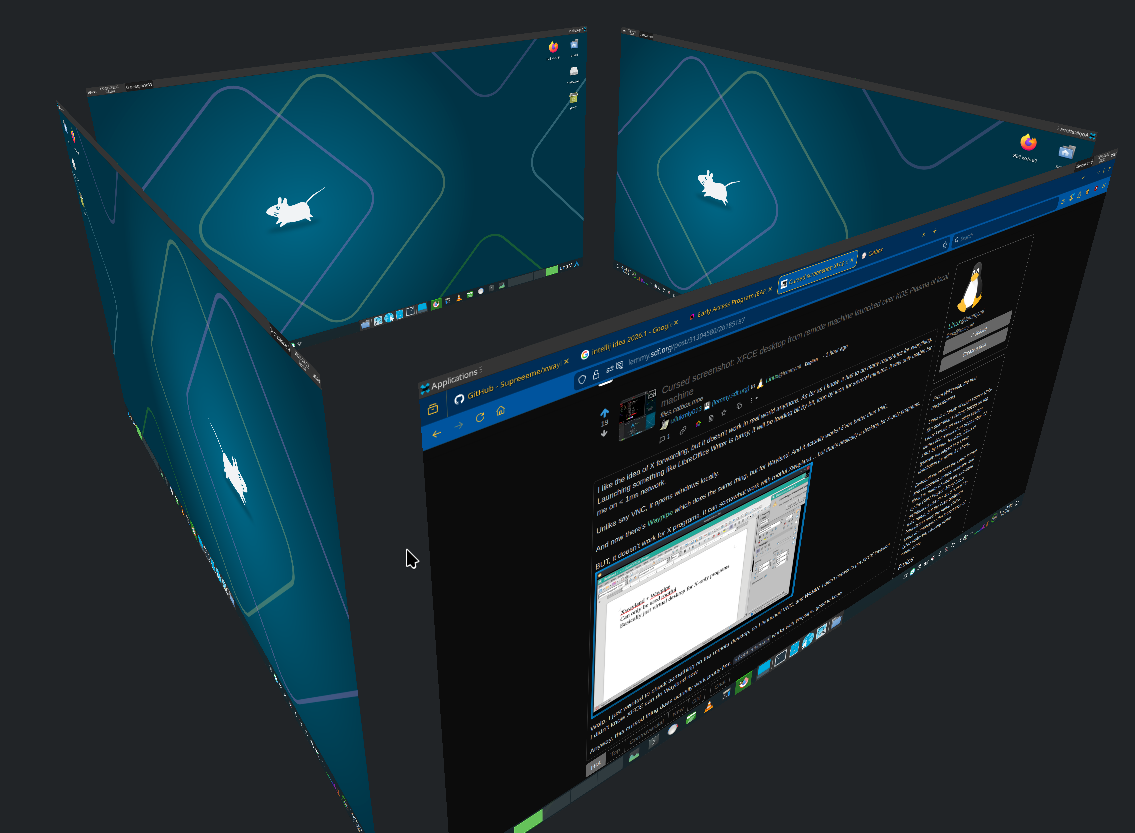
I didn’t know XFCE supported Wayland , so I casually ran vncserver, which launched xfce4-session, except that it attached itself to the Wayland display (proxied to my local machine) rather than X display of TigerVNC. And here come the full XFCE right to my local machine (which is running Plasma).
Only if the machine is on LAN. I am running with 250ms here.
No, I was not using VNC. VNC xstartup script just launched xfce4-session which connected to Waypipe rather than Xtigervnc.
It does integrate itself to KDE nicely. Even with virtual desktops. And it even properly does the animations. Downside is, I can’t access the original desktop on my laptop while it’s running. Peek at desktop also shows XFCE.
Here’s the cube switcher, showing XFCE instead:
Probably snaps too.
OK, but seriously, X, Y and Z are these:
Reboot
DISM.exe /Online /Cleanup-image /Restorehealth
sfc /scannow
The only answers you’ll get.


That was where I went “holy hell”. Wearing out ports is something I am constantly quite scared of when plugging things in. Especially things like cables when they want to twist vertically, but the port is horizontal, and, well, it’s a thick cable, so…