

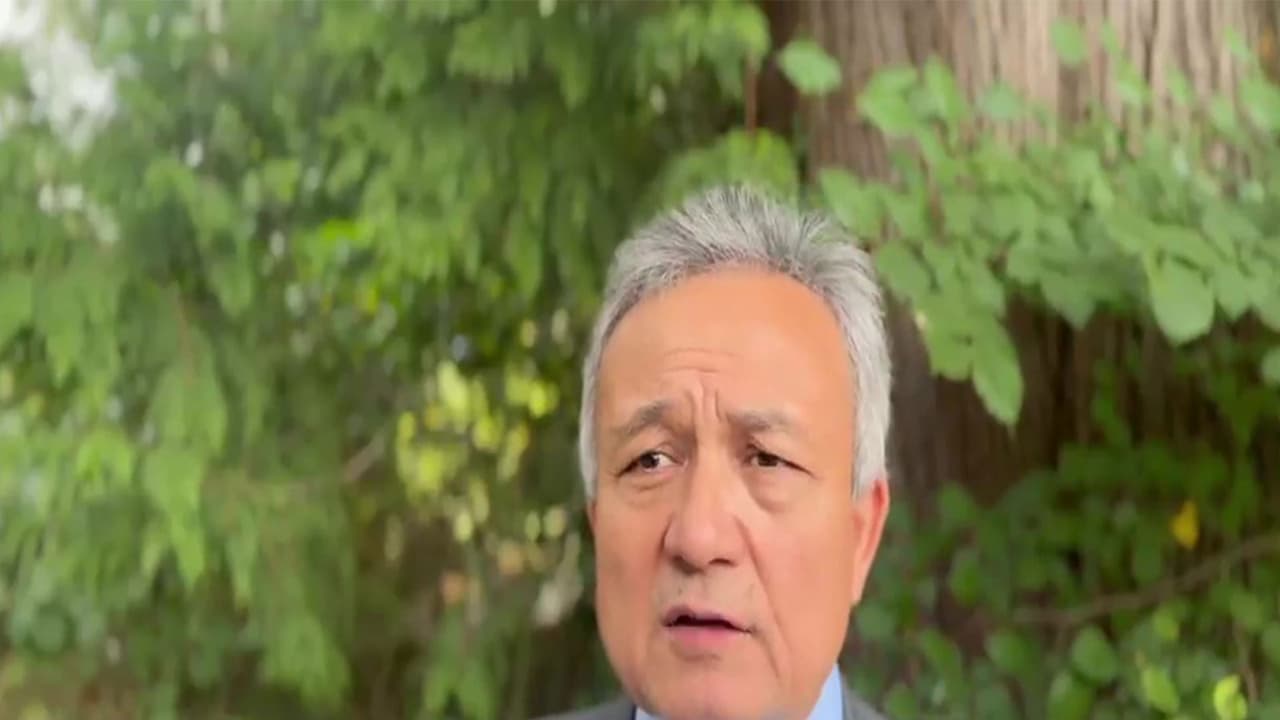
Concerns over China’s policies toward Uyghurs were raised by Dolkun Isa, President of the Germany-based Uyghur Center for Democracy, on the sidelines of the 63rd session of the United Nations Human Rights Council (UNHRC) in Geneva.
[…]
He pointed to growing international pressure, including a UN report on Uyghurs, the Uyghur Tribunal verdict and the recognition of a motion on alleged Uyghur genocide by the Mozambique Parliament.
“There is growing international pressure from the UN report on Uyghurs, the Uyghur Tribunal verdict, and the Mozambique Parliament recognising a motion on Uyghur genocide. A lot of international media have also covered this,” he said.
“So, China cannot continue hiding the reality. The Chinese government is now trying to hide and whitewash what I describe as the ongoing Uyghur genocide by slightly changing its tactics and strategy,” Isa said.
[…]
From Communication Blackout to ‘Propaganda Tours’
Recalling restrictions imposed since 2017, Isa said communication between Uyghurs and the outside world had been severely curtailed.
“Since 2017, China has cut off all communication. It cancelled all international flights between Urumqi and other countries, cut internet communication, and collected the passports of Uyghurs. No one could travel,” he said.
[…]
The Chinese government had subsequently changed its approach by allowing visitors to travel to the region.
He alleged that the government also organised what he described as propaganda tours for foreign journalists, diplomats and scholars.
“The Chinese government organised propaganda tours, inviting journalists, diplomats and so-called scholars. They paid for business-class flights, five-star hotels and everything, and organised everything very carefully,” Isa said.
He said such visits were aimed at creating an impression that conditions in the region were gradually returning to normal.
[…]
Isa further alleged that Uyghurs continued to face detention and forced labour.
“Millions of people are still suffering in concentration camps. Forced labour is still a critical issue. There are people being forced into labour both inside and outside the camps,” he said.
“More than one million Uyghur children are also still separated from their families,” Isa added.
Referring to China’s ethnic unity law, Isa said, “Recently, on July 1, China’s Ethnic Unity Law came into effect. So, it is a very dangerous situation.”
He also raised concerns over the status of Uyghur and Tibetan languages, saying, “Today, the Uyghur and Tibetan languages continue to be completely eradicated from daily life and schools, at every level.”
[…]
Isa said that the situation might not always be immediately visible to visitors travelling to the region, but alleged that pressure on Uyghurs had continued to intensify.
“If you just go there, maybe you cannot see it visibly. But actually, the pressure has been getting stronger recently,” he said.
[…]
“China won’t allow people to visit! What are they hiding?”
“China will allow people to visit! They’re trying to whitewash what’s happening!”