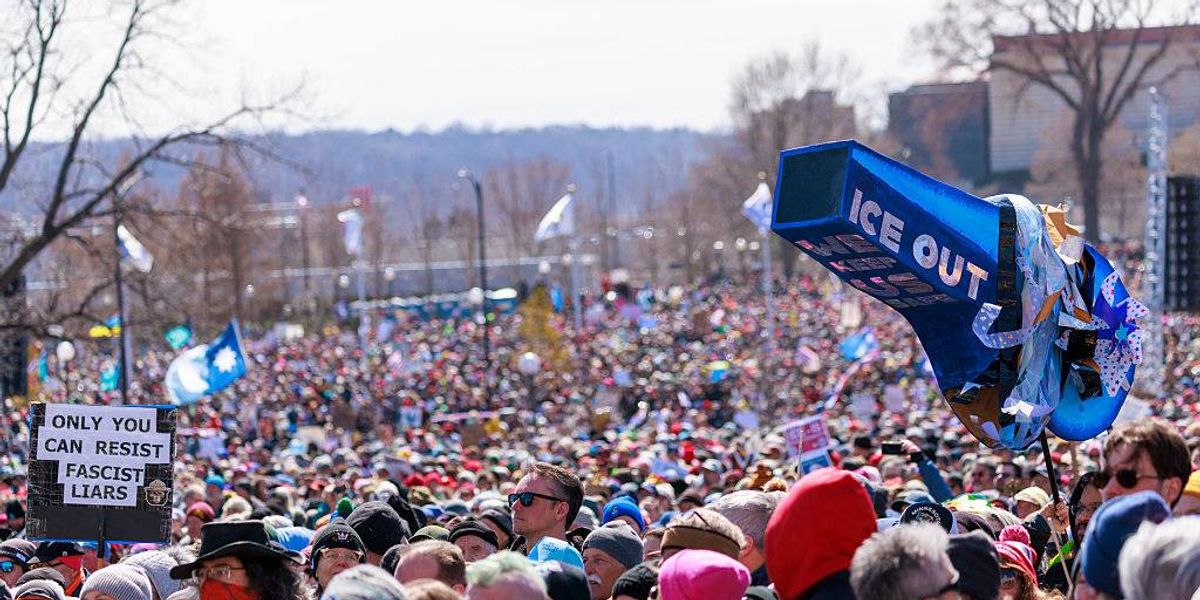
Millions across the US rallied against Trump's authoritarian agenda in nationwide No Kings protests, featuring speeches, performances, and massive crowds.
Demands are the concrete expression of class interest. A movement that refuses to articulate specific objectives is not a political force. It is a cultural festival. Material conditions do not shift because people gather in large numbers. They shift when production halts and when power is directly challenged. To say the citizenry is not in charge of fixing the country is defeatist idealism (a blatantly ridiculous fiction). It surrenders agency to the bourgeoisie. The masses create history but only when they are organized to seize it.
You claim these gatherings are the largest in history yet business continues as usual. Capital flows uninterrupted. The stock market does not tremble at a parade. Where is the general strike? Where is the material cost to the ruling class? Without economic leverage, visibility is meaningless. Western liberal protest culture trains people to believe that moral visibility equals victory. This is a deliberate falsehood designed to protect property relations. History shows that concessions are never granted out of goodwill. They are extracted through force and disruption.
Look at the historical record without the imperialist filter. Gandhi is presented as the saint of nonviolence who shamed the British Empire into leaving. This erases the material reality of the struggle. The British did not leave because of salt marches. They left because the Royal Indian Navy mutinied in 1946 and violent uprisings made the colony too expensive to maintain. The nonviolent narrative is a tool to disarm future movements. The same sanitization happened to Nelson Mandela and the ANC. He is remembered as a peacemaker but he led Umkhonto we Sizwe. The apartheid regime negotiated because they were being bled by armed struggle and mass disruption. They did not negotiate because of moral appeals.
Martin Luther King Jr is held up as the sole face of Black liberation who won through peace. This ignores the material pressure that actually forced legislation. King himself called riots the language of the unheard. The Civil Rights Act and the Fair Housing Act were passed while American cities were burning. The ruling class conceded rights to pacify the unrest and protect property. The radical elements who advocated for self defense and disruption created the pressure that made the moderates successful. To ignore this is to ignore how power actually works.
These current gatherings are different because they are safe for capital. Police allow them. Businesses prepare for them like weather events. There is no risk to the state. This is why they are parades and not protests. They function as a pressure valve to dissipate revolutionary sentiment. People feel they have acted because they showed up. Their energy is funneled into spectacle rather than organization. This serves the state by preventing the formation of actual revolutionary capacity.
Chairman Mao taught that revolution is not a dinner party. It is an act of violence by which one class overthrows another. These events are dinner parties. They may serve as recruiting grounds but calling them protests lies about the nature of struggle. Real action requires risking comfort. It requires disrupting the flow of capital. If there is no cost to the oppressor there is no victory for the oppressed.
Edit: Oh there’s another possible one day “strike” wow. You really should stop being such a pretentious ass and actually try engage with what’s being said.
Just a small clarification, Gandhi’s nonviolent protests were very much attacking the British. Non violence here only meant not to physically cause harm to humans. For example, the non cooperation movement involved boycott of British manufactured goods, returning titles and honours given by the British govt., and mass resignation of Indians from various offices and posts, strikes in factories. It was not a march for one day. It was specifically targeting the system and weakening it.
Maybe I phrased it badly but that’s the point I was trying to make the Indian resistance movement that Ghandi was the face of (both the sections he directly lead and the movement as a whole) was far more confrontational and active than the image canonised later by imperial powers of the hunger striking saint reaching freedom for India through moral appeals. Just like Mandela, MLK etc. the real movement was sanitised and laundered to curb future protests.
Oh, I misunderstood you. I get your point now. Our government too uses the image of ‘non violent’ protests by Gandhi to shut down protests here. The words they use went from non-violent protests to peaceful protests to protesting without disrupting public life (like don’t strike, don’t block roads etc.) What the hell is a protest if it does not disrupt?


Demands are the concrete expression of class interest. A movement that refuses to articulate specific objectives is not a political force. It is a cultural festival. Material conditions do not shift because people gather in large numbers. They shift when production halts and when power is directly challenged. To say the citizenry is not in charge of fixing the country is defeatist idealism (a blatantly ridiculous fiction). It surrenders agency to the bourgeoisie. The masses create history but only when they are organized to seize it.
You claim these gatherings are the largest in history yet business continues as usual. Capital flows uninterrupted. The stock market does not tremble at a parade. Where is the general strike? Where is the material cost to the ruling class? Without economic leverage, visibility is meaningless. Western liberal protest culture trains people to believe that moral visibility equals victory. This is a deliberate falsehood designed to protect property relations. History shows that concessions are never granted out of goodwill. They are extracted through force and disruption.
Look at the historical record without the imperialist filter. Gandhi is presented as the saint of nonviolence who shamed the British Empire into leaving. This erases the material reality of the struggle. The British did not leave because of salt marches. They left because the Royal Indian Navy mutinied in 1946 and violent uprisings made the colony too expensive to maintain. The nonviolent narrative is a tool to disarm future movements. The same sanitization happened to Nelson Mandela and the ANC. He is remembered as a peacemaker but he led Umkhonto we Sizwe. The apartheid regime negotiated because they were being bled by armed struggle and mass disruption. They did not negotiate because of moral appeals.
Martin Luther King Jr is held up as the sole face of Black liberation who won through peace. This ignores the material pressure that actually forced legislation. King himself called riots the language of the unheard. The Civil Rights Act and the Fair Housing Act were passed while American cities were burning. The ruling class conceded rights to pacify the unrest and protect property. The radical elements who advocated for self defense and disruption created the pressure that made the moderates successful. To ignore this is to ignore how power actually works.
These current gatherings are different because they are safe for capital. Police allow them. Businesses prepare for them like weather events. There is no risk to the state. This is why they are parades and not protests. They function as a pressure valve to dissipate revolutionary sentiment. People feel they have acted because they showed up. Their energy is funneled into spectacle rather than organization. This serves the state by preventing the formation of actual revolutionary capacity.
Chairman Mao taught that revolution is not a dinner party. It is an act of violence by which one class overthrows another. These events are dinner parties. They may serve as recruiting grounds but calling them protests lies about the nature of struggle. Real action requires risking comfort. It requires disrupting the flow of capital. If there is no cost to the oppressor there is no victory for the oppressed.
Edit: Oh there’s another possible one day “strike” wow. You really should stop being such a pretentious ass and actually try engage with what’s being said.
Just a small clarification, Gandhi’s nonviolent protests were very much attacking the British. Non violence here only meant not to physically cause harm to humans. For example, the non cooperation movement involved boycott of British manufactured goods, returning titles and honours given by the British govt., and mass resignation of Indians from various offices and posts, strikes in factories. It was not a march for one day. It was specifically targeting the system and weakening it.
Maybe I phrased it badly but that’s the point I was trying to make the Indian resistance movement that Ghandi was the face of (both the sections he directly lead and the movement as a whole) was far more confrontational and active than the image canonised later by imperial powers of the hunger striking saint reaching freedom for India through moral appeals. Just like Mandela, MLK etc. the real movement was sanitised and laundered to curb future protests.
Oh, I misunderstood you. I get your point now. Our government too uses the image of ‘non violent’ protests by Gandhi to shut down protests here. The words they use went from non-violent protests to peaceful protests to protesting without disrupting public life (like don’t strike, don’t block roads etc.) What the hell is a protest if it does not disrupt?
A parade