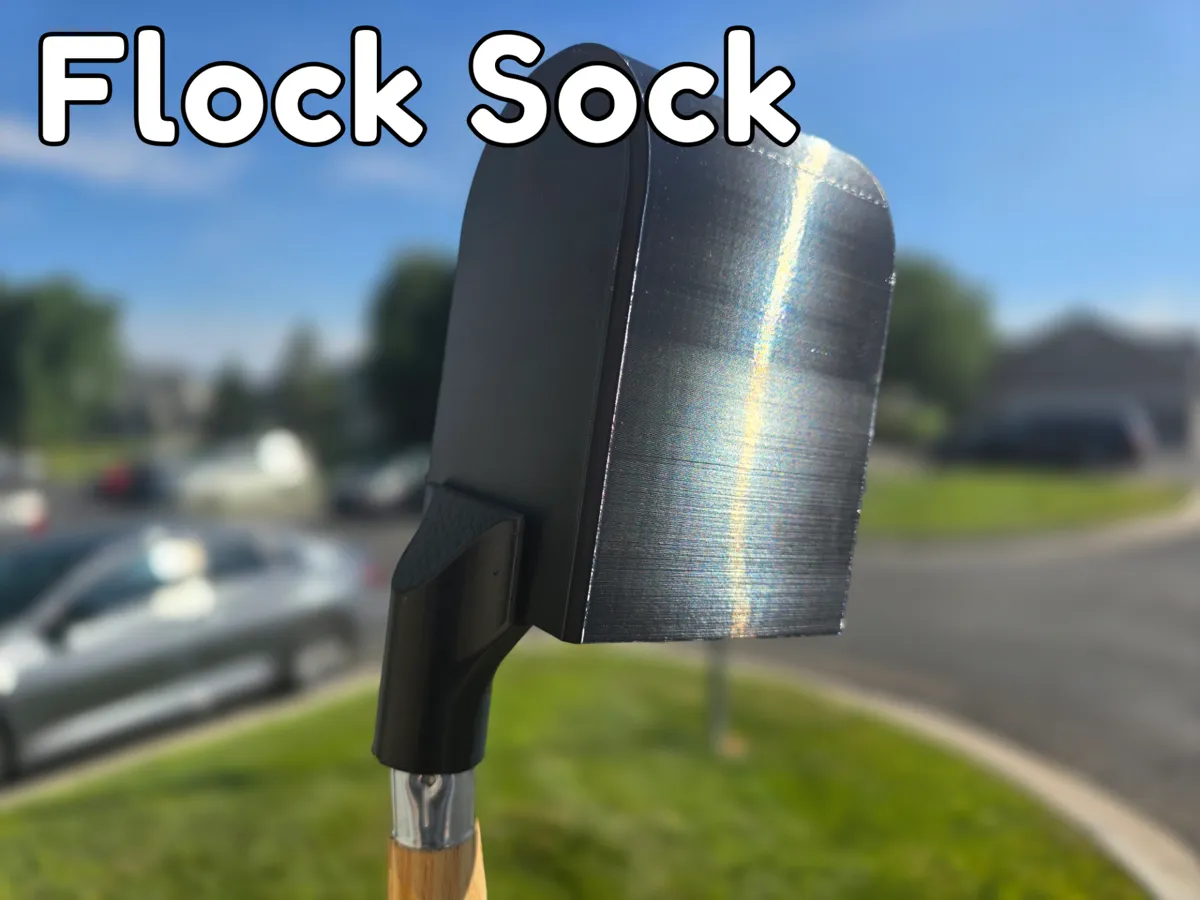
Download this free 3D print file designed by SquidInk. Boost MePrivacy is a public right. If you believe in keeping eyes off your everyday moves and appreciate low cost, zerodamage counter tools, throw a Boost my way!The Flock SockSometimes a camera just needs a sock. The Flock Sock is a slip on cover designed to help protect a Flock camera from the harmful radiation of the sun. Your city spent their very own hard earned tax dollars scattering these cameras everywhere to keep you safe, all it cost you was a little privacy. The very least you can do is help protect these valuable civil servants from getting a bad sunburn.FeaturesRapidly deployable: Slides over the top in seconds using any standard 1 inch (25.4mm) pole or broomstick. Gravity will do the rest.Safe deployment: No need to risk your life on a ladder, the structural integrity of your car at high velocity, or the dangers of a chainsaw. Just need a broomstick.100% non-permanent: No glue, no screws, and zero structural changes. Because it pops off instantly with absolutely no damage caused and costs exactly $0 to revert, it conveniently avoids some of the troublesome labels that Uncle Sam might stick to you. It's just a removable accessory.Subtle Profile: Look at the subtle off-black coloring. The tastefull thickness of it. Oh, my God, it even hides Flocks watermark.Rear Cutout: The back of the Flock Sock is designed to easily fit over any Flock camera with being obstructed by its mounting bracket or connection cable.Print profile includesFlock Sock (cover)Flock Sock Socket (pole/broom adapter)Print RecommendationsABS/ASABest choice for outdoor use. Excellent heat and UV resistancePETGWorks well but prolonged summer heat may cause the cover to soften or deformPLAIdeal if you prefer your Flock Sock to develop a long term relationship with the summer heat.PSA: Flock has 3 different common models deployed. I am working on a profile for each of them and will upload when theyre complete
Sometimes a camera just needs a sock.
The Flock Sock is a slip on cover designed to help protect a Flock camera from the harmful radiation of the sun. Your city spent their very own hard earned tax dollars scattering these cameras everywhere to keep you safe, all it cost you was a little privacy. The very least you can do is help protect these valuable civil servants from getting a bad sunburn.
Copyleft is a way of using the copyright on the program. It doesn’t mean abandoning the copyright; in fact, doing so would make copyleft impossible. The “left” in “copyleft” is not a reference to the verb “to leave”—only to the direction which is the mirror image of “right.”
Public domain, OTOH, which is what you seem to be promoting, is a gift to AI tech bros, who want to behave as the middlemen described in the same article:
[IP] in the public domain, uncopyrighted … allows people to share [it], if they are so minded. But it also allows uncooperative people to convert [it] into proprietary [IP]. They can make changes, many or few, and distribute the result as a proprietary product. People who receive the [latter] do not have the freedom that the original author gave them; the middleman has stripped it away.
Ideally we’d eliminate copyright law and replace it with copyleft law
Fair enough, but it would still regulate what people can legally do with creative works. So, it would still be IP law - which a few comments ago you implied couldn’t/shouldn’t exist.

You seem to be confusing copyleft with public domain.
They are not the same.
Copyleft licenses entirely rely on copyright law. In the words of the people who invented copyleft:
Public domain, OTOH, which is what you seem to be promoting, is a gift to AI tech bros, who want to behave as the middlemen described in the same article:
I’m not confusing it. I’m aware if it.
We built what we have within the framework of laws made for the purposes of capitalistic domination.
Ideally we’d eliminate copyright law and replace it with copyleft law. As of now, no copyleft laws exist
Fair enough, but it would still regulate what people can legally do with creative works. So, it would still be IP law - which a few comments ago you implied couldn’t/shouldn’t exist.