
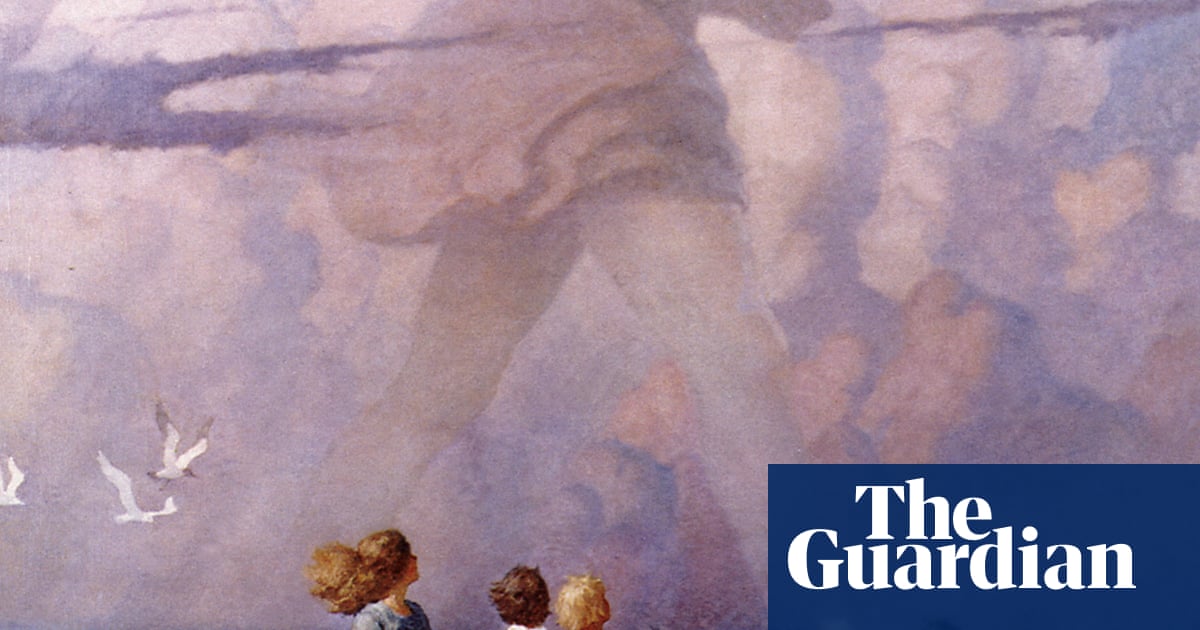
The six children sit together at the waterline in roaring wind. Seagulls dip and strain, beating their wings against the gusts as, far below, waves crest, thump, whisper. A girl, scarcely three years old, stands suddenly and looks out towards that horizon. Striding past them in the distance, his immense feet hidden beneath the rim of the horizon, is a giant.
American artist NC Wyeth painted The Giant in 1923. The low angle emphasises the giant’s immensity, and all the children’s faces are turned away from the viewer. In this way, those children become anyone we care to transpose into this magical scene. What child has not lain in the grass to watch some cloud-image, an animal perhaps, gradually dissolve into the amorphous collection of water droplets that are its banal reality?
Why has Wyeth instilled this sense of nostalgic impermanence into his painting about imagination?
Almost every corner of western society views imagination as the domain of early childhood, those fleeting years when giants made of cloud seem possible. This explains why the word “imagination” disappears from Victorian education department curriculum documents well before children reach high school – not that it appears much prior to that.
Worse, most of us know instinctively that, in many adult contexts, the word’s connotations are at best ambivalent and at worst outright negative. Even being labelled a “dreamer” is rarely a compliment; when we laugh that something might happen only “in one’s dreams”, we seem to be mocking not only an individual’s hopes, but their time spent building such imaginative constructions in the first place.
most of us know instinctively that, in many adult contexts, the word’s connotations are at best ambivalent and at worst outright negative
That’s not an accident.
The goal is specifically to stifle and ultimately destroy imagination - to render an individual fit for nothing more than being slotted into an established system.
And the more abusive and broadly destructive the system is - the more it’s been warped by a few to their own benefit at the expense of everyone else - the more ruthlessly must imagination be stamped out.
(And conveniently enough, those who manage the system generally don’t have to do much of anything to see to it that imagination is crushed. The earlier products of the system, embittered by their own loss, are generally eager to tear the next generation down to their level on their own.)
The dirty little secret is that the education system is a conformity production line, even gate keeping wealthy society by a student’s ability to conform.
Find exams dumb and pointless and never get a good justification for their significance and so struggle to care and perform well at them? Sorry, you’re out of the pipeline.
Which doesn’t mean learning and assessment are useless. It’s just clear that the emphasis of the system is very mechanical.
The education system is not about education it’s about gatekeeping and enforcing conformity. As a victim of the system I think it needs to be totally returned from first principles
There are so many issues with my educational experience that I don’t know where to start. I was sent to the principal’s office for claiming negative numbers existed in first grade. The next year, my parents enrolled me in a night class at ASU for intermediate algebra. Back in elementary school, best they could do was sixth-grade math – i.e., not even prealgebra. It took six years – until eighth grade – for me to progress in math from when I was fucking 7.
By high school, I was considered an excellent math student, and I was told two specific things from other departments: Don’t go into writing or publication design – you’re a math student who’s terrible at both.
Of course, when I won national awards for both and rubbed their noses in it when back home visiting my parents, they tried to do the whole “we knew you had it in you all along” thing.
Yeah, no. I don’t like regurgitative analysis of 19th-century works, and your yearbook design sucks. That’s on you, not me.
Ah yes.
I already knew how to read when I started first grade, so my introduction to the reality of education was a teacher telling me to “stop showing off” when I raised my hand to volunteer to read out loud.