
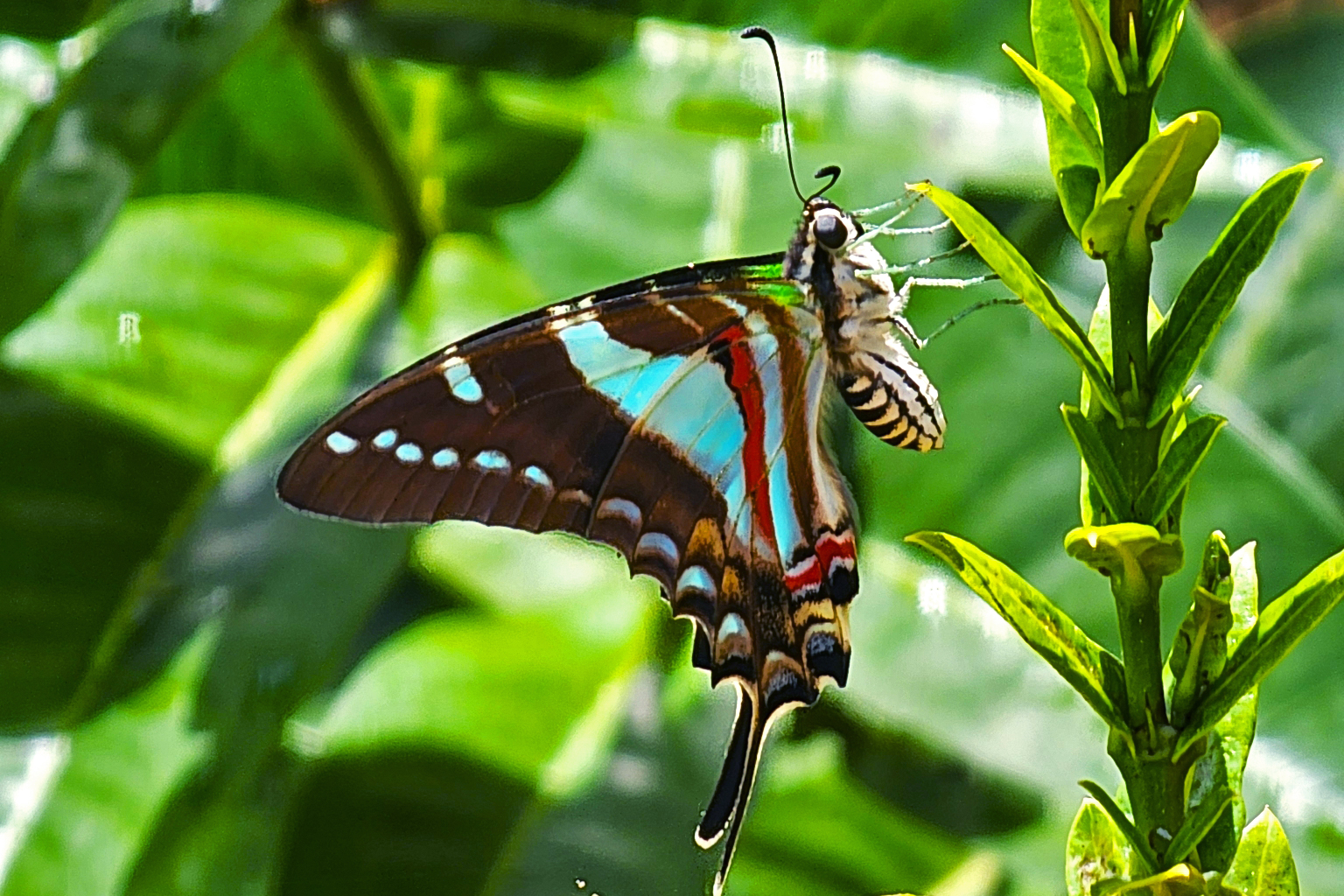
Banner image: Deforestation, climate change and trade pose threats to the species, which has dwindled to a few hundred from some 750,000 in the 1960s. Image by kaysud via iNaturalist (CC BY-NC 4.0).
US proposes endangered species protections for an imperiled Jamaican butterfly
- The U.S. has proposed listing a rare butterfly from Jamaica, the Jamaican kite swallowtail under the Endangered Species Act.
- The striking blue-green and black butterfly, endemic to this island country, hovers on the brink of extinction. Scientists have observed no more than 250 adults in the wild in recent years.
- Deforestation, devastating hurricanes and droughts on the island have destroyed much of this butterfly’s breeding sites; only four remain. Demand for framed butterflies used in home decor is another factor in their disappearance.
- ESA listing would bring attention to the species and stop its trade in the U.S. Conservationists hope it will also fund efforts to protect the butterfly’s habitat.
The U.S. Fish and Wildlife Service (USFWS) recently proposed listing Jamaica’s most imperiled butterfly, the Jamaican kite swallowtail, as endangered under the Endangered Species Act (ESA).
The species (Protographium marcellinus), a small, fast-flying butterfly, flutters through its limestone forest home. Its wings, painted in streaks of bright turquoise and black with a dash of red, sport long, narrow tails.
These charismatic butterflies live on this island and nowhere else. In recent years, they’ve nearly disappeared. Back in the 1960s, scientists recorded about 750,000 individuals; that number has plummeted to between 50 and 250 today. In some years, they’ve seen none.
It’s such an alarming decline that scientists say this swallowtail should jump two categories on the IUCN Red List, from vulnerable to critically endangered.
“This listing would be a real turning point for this species,” said Dianne DuBois, senior scientist at the U.S.-based NGO Center for Biological Diversity, which has been fighting for ESA protections for the butterfly since 1994. After a few failed attempts, it sued USFWS in 2021, which resulted in the agency drawing up the current proposal.
ESA listings prevent extinction in 99% of the species under the act, but the wait is often quite long, about 12 years on average. Time may not be on its side for the Jamaican kite swallowtail, which hangs on the brink of extinction.
“We wish this proposal had come three decades ago,” DuBois said. “We really want to urge the Fish and Wildlife Service to work quickly to finalize these protections and let the ESA work its magic.”
Vaughan Turland at Jamaica’s Windsor Research Centre, who has studied the species for decades, welcomed the U.S. proposal. “Any formal recognition of the potential demise of such an iconic species is important,” he said, because it raises awareness and urges urgent conservation actions.

The Jamaican kite swallowtail is a small, endemic species that lives in Jamaica’s limestone forests. Image by Vaughan Turland.
Hammered by vanishing habitat, climate change and trade
Jamaica is rapidly losing its forests, and along with it, the Jamaican kite swallowtail is losing its homelands. Trees are felled to make way for mines, quarries, expanding farmlands, human settlements and livestock grazing.
Baby caterpillars feed only on the leaves of the black lancewood trees (Oxandra lanceolata) found in limestone forests. Cocooned pupae stay buried in the leaf litter for months before turning into showy butterflies. Meanwhile, black lancewood is targeted by loggers: Thousands of these trees are cut down to make furniture, fish pots, stakes for growing yams and charcoal for cooking, among other things.
As a result, the butterfly’s breeding habitat has shrunk by about 70% since the 1960s, according to a study by Turland and his colleague Thomas Turner from the Florida Museum of Natural History, who’s also considered an authority on the species. Today, the swallowtails breed in just four sites on the island where a few dense stands of black lancewood remain.
Extreme weather events, including hurricanes and drought, pose an increasing threat. Hurricane Melissa, one of the strongest hurricanes on record in the Atlantic basin, made landfall in Jamaica in October 2025, damaging one of the butterfly’s few remaining breeding sites, Turland said.

Caterpillars only eat the leaves of the black lancewood trees, which are logged by the thousands to make furniture, fish pots and charcoal, and more. Image by Vaughan Turland.
Because of its striking appearance, the rare butterfly is also in demand for home décor, framed and hung on the wall. It’s part of a massive trade that includes more than 3,700 butterfly species the world over, mostly coming from the Global South. They’re bought primarily by consumers in the U.S. and Europe.
Fewer than 70 butterfly species have trade protections under CITES, the global wildlife trade agreement. All others, including the Jamaican kite swallowtail, can be traded internationally without restrictions.
“The Jamaican kite swallowtails are one of many butterfly and invertebrate species that have kind of caught the eye of collectors that pin and frame them for display,” DuBois said.
How many are captured and sold remains unclear, as it’s illegal to catch them in Jamaica, but it’s likely a lucrative activity in a country where workers average $34 a day. Dubois said this butterfly sells online for as much as $178 apiece.
For an animal this rare, every sale matters. “Even low levels of collection can be devastating for a species with such a small population,” DuBois said.
This is where the ESA listing could make the most impact. If finalized, the listing would “ensure that this species no longer gets caught up in this popular online decor trade,” DuBois said. It could also bring more attention to the butterfly’s perilous state, and with it, funding to protect its habitat, she added.

(Left) Deforestation has resulted in a nearly 70% loss of the butterfly’s breeding sites. (Right) A Jamaican kite swallowtail. Images by Vaughan Turland and kaysud via iNaturalist (CC BY-NC 4.0).
The ESA listing proposal is currently open for comments until June 16, and it’s an open forum: Anyone with information about the species or who is interested in butterfly conservation can post statements. USFWS will then have a year to make its decision. If the listing is finalized, it would be the first addition to the ESA since U.S. President Donald Trump took office for his second term.
“If we can get it listed, there’s a very good chance that it will avoid extinction,” DuBois said.
Spoorthy Raman is a staff writer at Mongabay, covering all things wild with a special focus on lesser-known wildlife, the wildlife trade, and environmental crime.